

Ìtàn Adaba Dúdú – The Story of the Black Crow
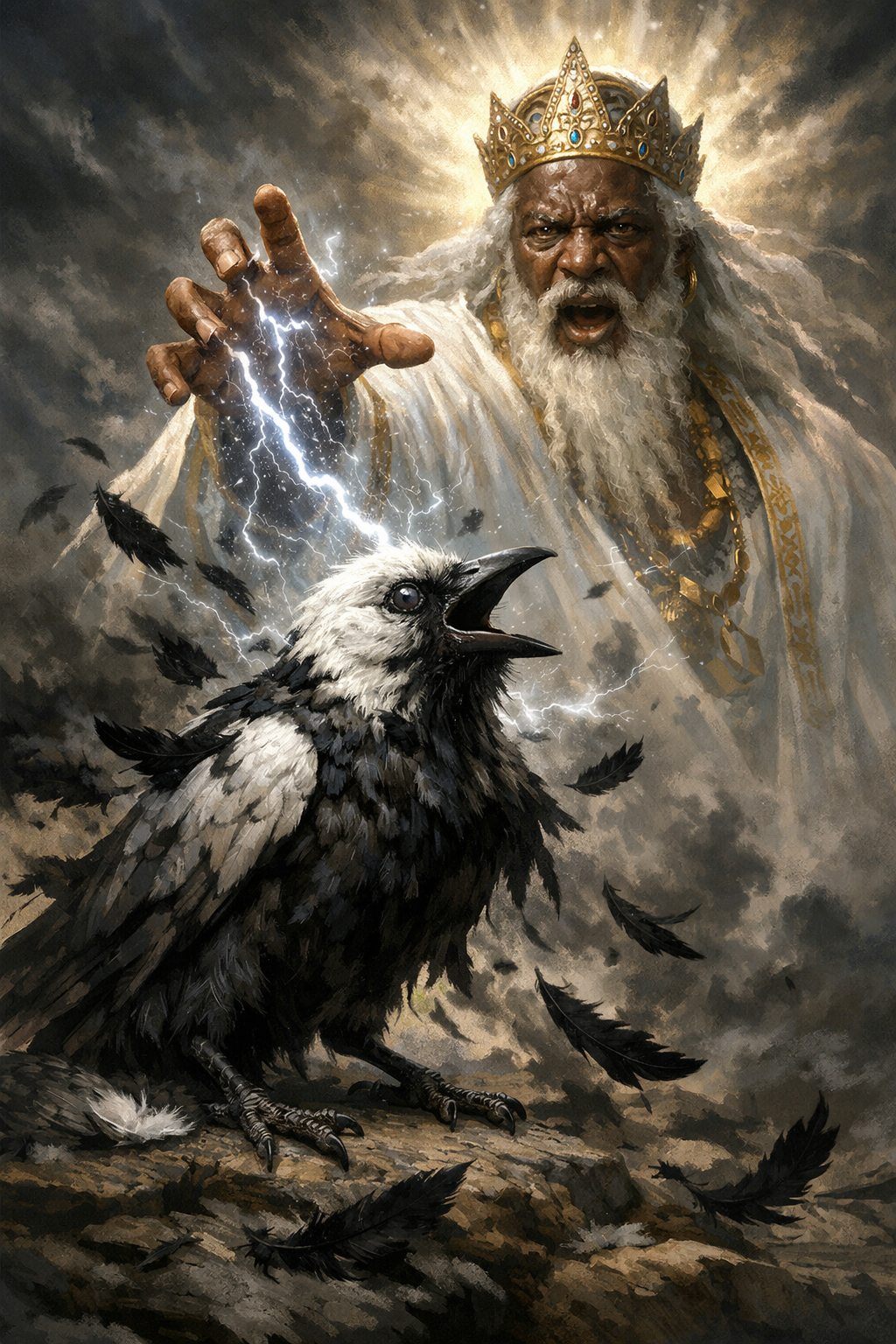
Long ago, when birds still spoke the language of humans and the forest listened closely, the crow was not black. Its feathers were bright like polished palm oil under the sun, and its voice was smooth and pleasant to hear.
In those days, Olódùmarè sent messages to the world through the birds. Each bird was chosen according to its character. The dove carried messages of peace. The parrot carried messages of wisdom. And the crow clever, fast, and observant—was trusted with messages of truth, even when the truth was heavy.
One season, famine came upon the land. The people prayed, and Olódùmarè prepared a message:
“Tell the people to share what they have. Those who hoard will suffer longer.”
The crow was given this message and sent down from the heavens.
But as the crow flew, it thought to itself:
“If the people share, there will be nothing left for me to steal. Why should I help them when I can help myself?”
So the crow altered the message.
It told the people:
“Hide what you have. Guard your food. Trust no one.”
The rich hoarded, the poor starved, and the land fell deeper into suffering.
Soon, the other birds noticed something was wrong. The dove saw neighbors fighting. The rooster saw children crying from hunger. The parrot listened and heard fear instead of hope.
They returned to Olódùmarè and spoke the truth.
When the crow was summoned, it could not deny its actions.
Olódùmarè said:
“You were trusted with truth, and you chose deception. You used intelligence without wisdom.”
As punishment, the crow’s bright feathers were turned black, the color of hidden deeds and unspoken guilt. Its once-sweet voice became harsh and cracked, so all would remember its betrayal when it spoke.
But Olódùmarè did not destroy the crow.
Instead, Olódùmarè said:
“From this day forward, you will walk between worlds.
You will eat what others discard.
You will warn people not with beauty, but with presence.
When you appear, they will know to look closely at what is wrong.”
That is why, in Yorùbá thought, the crow is not evil but serious.
It is a reminder.
Intelligence without integrity brings darkness.
Truth, once twisted, leaves a mark that cannot be washed away.
And so, when a crow calls near a village, elders say:
“Something unseen is speaking. Pay attention.”
Connecting with ase
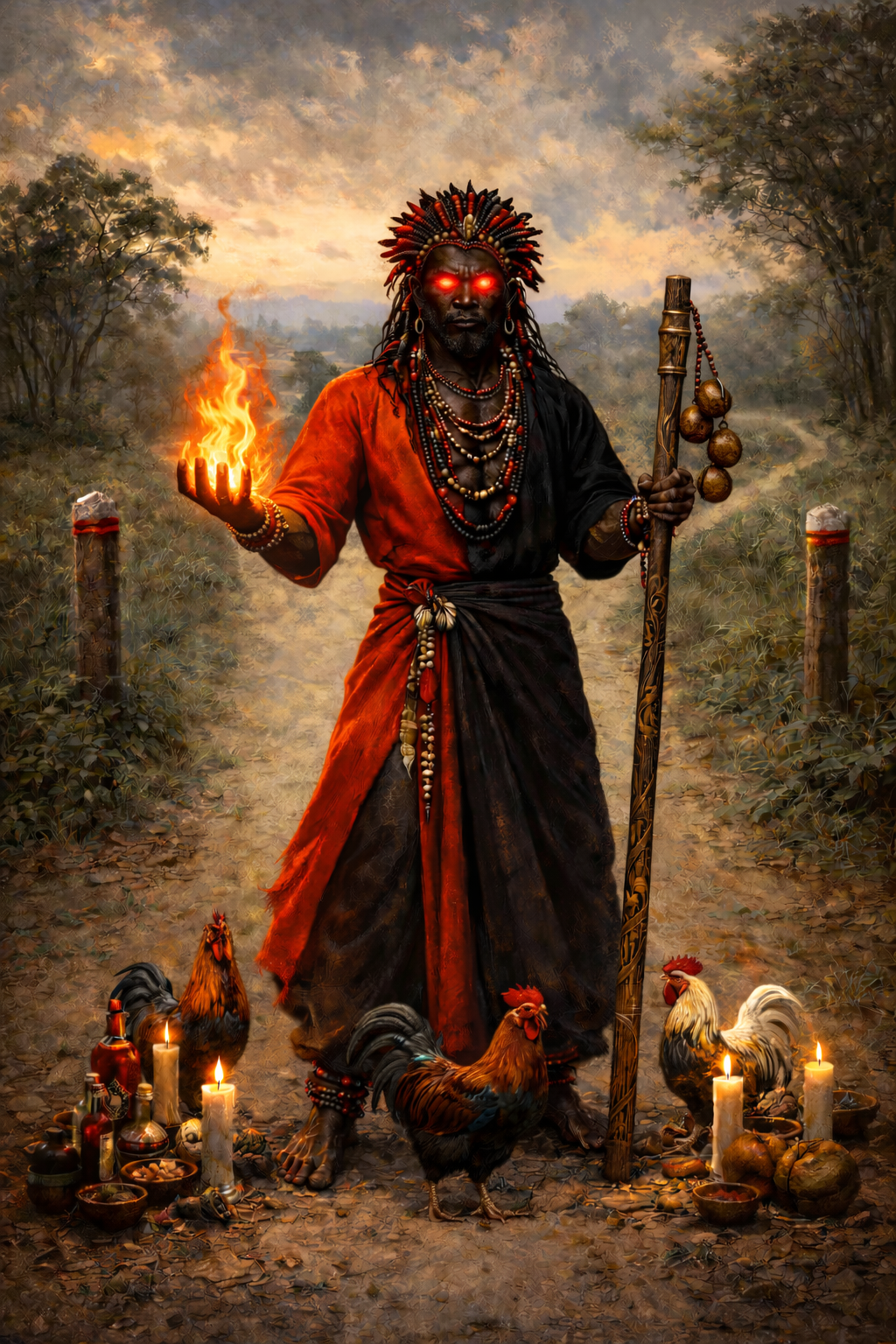
ÈṢÙ PLAYS BOTH VILLAIN AND HERO
Long ago, in the village of Orù, there lived a woman named Ajàbí who could not bear children. Her heart was heavy with sorrow, so she went to consult a babaláwo.
“I long to have a child,” she said. “What must I do?”
The babaláwo cast Ifá and spoke:
“Ifá says you will soon conceive, but before this can happen, you must offer sacrifices to Èṣù.”
Ajàbí asked, “What sacrifices must I offer?”
The babaláwo replied, “You must offer one goat, one black rooster, one gourd of palm wine, one gourd of palm oil, and sixteen thousand cowries.”
“I will offer them,” Ajàbí promised.
The babaláwo then warned her, “After your child is born, you must never allow yourself to fall into anger.”
“I will be careful,” she said.
“There is one more thing,” the babaláwo added. “One day, this child will wander away and be lost.”
Ajàbí gasped. “Will I ever find my child again?”
“Yes,” said the babaláwo, “but only if you do not neglect your sacrifices.”
Ajàbí fulfilled every instruction. Sixteen days later, she conceived. Nine months later, she gave birth to a baby boy and named him Rósìjí, meaning ‘remain under my protection.’
Out of fear of losing him, Ajàbí kept Rósìjí inside her hut at all times. She watched him closely, sheltered him constantly, and never let him wander. Because of this, Rósìjí grew spoiled and restless.
One day, he longed to play outside and explore the land beyond the hut. Ajàbí refused, fearing he would be lost. Rósìjí cried bitterly, throwing tantrums day and night until Ajàbí herself became exhausted and angry.
Outside the hut, Èṣù listened.
Knowing the child’s desire, Èṣù whistled a soft, enchanting melody. The sound calmed Rósìjí instantly but it also sent Ajàbí into a deep sleep. As the whistling continued, Rósìjí opened the hut door.
Then Èṣù sang:
Child, the door is open
Come and see how beautiful the land is
Come and see how magical the world is
Come out, little one, the door is open
Run free, child, run free
Unable to resist, Rósìjí followed the melody down the path and disappeared.
When Ajàbí awoke and found her child gone, she ran through the village crying his name. She searched everywhere, but he was nowhere to be found. Heartbroken, she returned to her hut.
There, she met a young man Èṣù in disguise.
“Why are you so sad?” he asked.
“My son is lost,” Ajàbí wept.
“Did you offer sacrifices before he was born?” the man asked.
“Yes,” she replied. “I offered them to Èṣù.”
“Then do not worry,” he said. “Èṣù will ensure your son finds his way home.”
With that, he vanished.
Along the road, Èṣù transformed himself into a dog and followed Rósìjí’s scent until he found the child asleep beneath an irókò tree. Èṣù placed food nearby and whistled softly. Rósìjí awoke, ate, and followed the sound once more.
In this way, Èṣù led the child step by step back toward home.
When Rósìjí finally returned, Ajàbí rejoiced. The villagers came to celebrate with her.
One woman said, “You are truly blessed. Your son could have been lost forever.”
Ajàbí replied, “It was Èṣù who guided my child back to me.”
Together, the people sang praises:
Èṣù is powerful and must never be forgotten!
Èṣù turns right into wrong and wrong into right
Èṣù walked the land and found Rósìjí
Èṣù accepted sacrifice and gave àṣẹ to Ajàbí
Èṣù is powerful and must never be forgotten!
Thus, Èṣù played both villain and hero
and in the end, all praised his name.
Delving into ifa's wisdom
Ifá wisdom is the philosophical, ethical, and cosmological knowledge preserved within the Yoruba spiritual tradition. It is not abstract theory it is applied wisdom meant to guide human life toward balance, longevity, and alignment with destiny.
NARRATIVES OF ÌYÀMI-ÀJÉ-ẸLẸYẸ-ODÙ
Ò! Ìyàmi!
Ò! My Elder Mother!
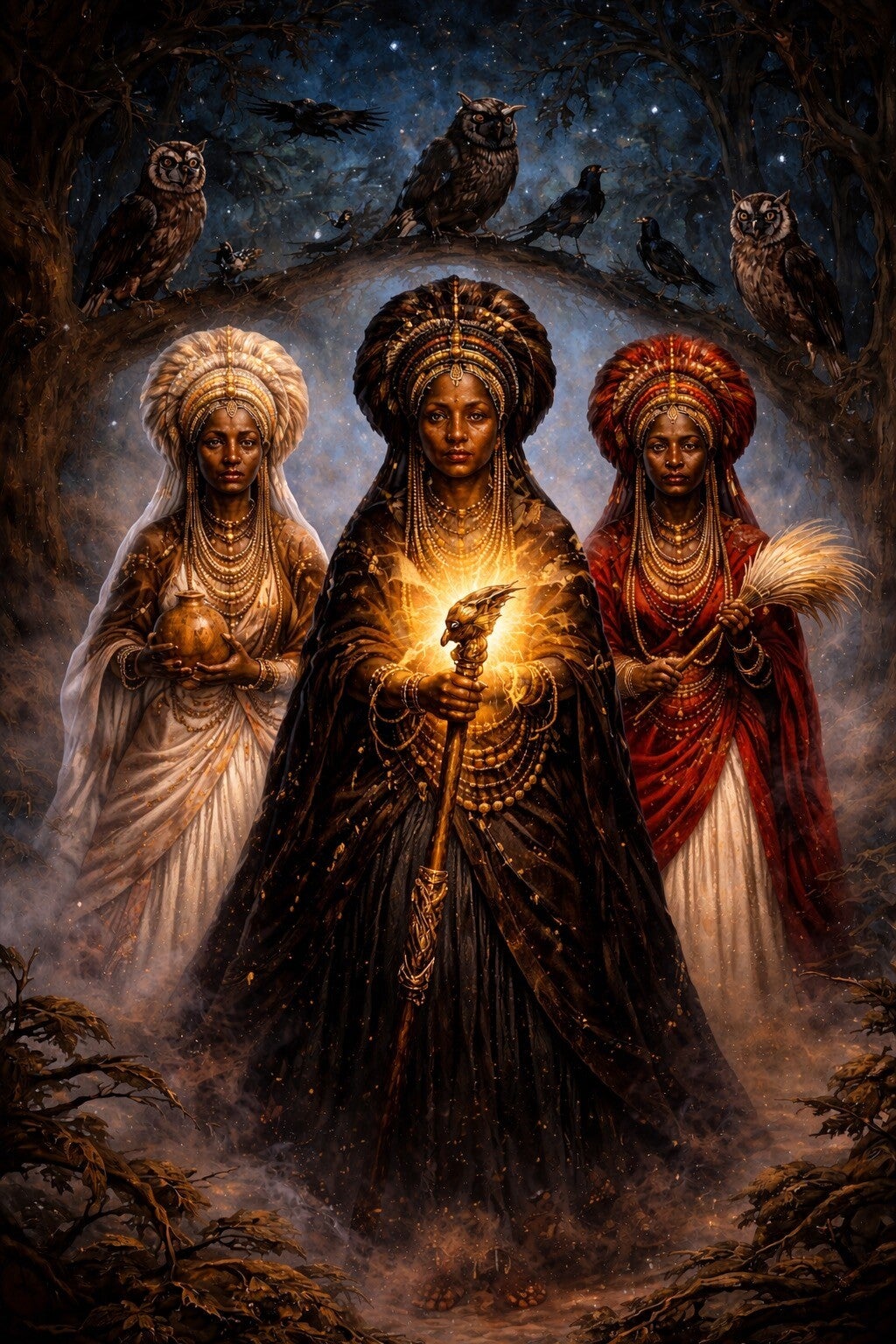
Ìyàmi Osòròngà is the highest manifestation of Ìyàmi Àjẹ the Most Powerful Mother. She embodies an ancient and overwhelming feminine force, equal in potency to that of Esu. She is a divinity both deeply feared and profoundly revered. Her power is absolute, and her presence commands respect.
The worship of Ìyàmi Osòròngà is intensely matrifocal and exclusively feminine. Men are forbidden from participating in her rituals, for her mysteries belong solely to women. When the true name of an Àjẹ is unknown, she is addressed through familiar and reverent titles: Ìyàmi Osòròngà, my mother the sorceress; Ìyàmi, my mother; Elẹ́yẹ, owner of the bird; or Agà / Ìyá Àgbà, the Elder Mother.
In Yoruba usage, the word Iyámi (“my mother”) follows different orthographic rules depending on context. When referring to ordinary mothers, it is written Ìyámi. However, when referring specifically to the Powerful Mothers the Ìyàmi Osòròngà—the correct form is Iyami, which is used throughout this narrative.
ÌYÀMI’S ARRIVAL IN THE WORLD
Long ago, Ifá was consulted on behalf of two hundred and one women who journeyed from Òrun (the spiritual realm) to Ayé (the earthly realm) to become owners of birds Elẹ́yẹ.
When these women arrived on earth, the babaláwo instructed that a gourd be given to each of them. Their first place of settlement was a land known as Otà. After establishing themselves, the women elected an Iyálódé, a leader among women. Any woman who wished to obtain a bird had to present her gourd to the Iyálódé and formally declare her intention.
Once her wish was accepted, a bird was placed inside her gourd. The gourd was then sealed and returned to its owner. Each woman was required to guard her gourd with utmost secrecy and care. Only another gourd-owner could know its location. The gourd might be hidden on a rooftop, beside a wall, or buried in the earth—but only its owner knew precisely where it rested.
When the time came to send the bird Elẹ́yẹ on a mission, the woman would open her gourd and release it. The bird would fly to carry out its task wherever it was sent: Sapele, Ilorin, Ìbàdàn, Lagos, Abẹ́òkúta, the domain of an Oba, or even to the farthest corners of the world.
The bird obeyed without question.
If commanded to kill, it killed.
If ordered to retrieve a person’s intestines, it did so.
When seeking a victim, the Elẹ́yẹ would lie in ambush. The victim would not know that their body had been marked. If the victim was a pregnant woman, the bird would take what was within her womb. Whatever task was given, the bird fulfilled.
Once its mission was completed, the bird returned to the gourd its shelter and home. The owner would seal the gourd again and place it exactly where it had been before. The bird would then speak to its owner, saying:
“I have completed the work you sent me to do.”
If the intended victim possessed a powerful medicine or protection against Àjẹ, the victim would speak to the bird:
“The one who sent you will not have me.”
In such a case, the bird would return and report to its owner:
“I tried repeatedly, but I could not overcome this person. If you send me against one who has no protection against Àjẹ, I will succeed.”
Recognizing that such work could not be carried alone, the owner of the bird would then take the matter to her society of Àjẹ. She would address them:
“I sent my bird on a mission, but I cannot complete this work alone. I bring it before the assembly.”
The members of the society would divide the work among themselves. She would present the blood of the intended victim, passing it among them so that each might taste it. After drinking, they would disperse.
When night and day passed and the time returned, another bird would be sent. This bird would not allow the victim to sleep. It carried a whip, a knife, and a club in its claws. It could transform into a spirit from another world or take the form of an Òrìṣà, spreading terror and confusion upon the one it was sent to torment.
Such is the nature of the Elẹ́yẹ.
Such is the way of the Ìyàmi.
Oṣun Saves Humanity
One day, Olódùmarè, the Supreme Creator, became deeply troubled when word reached Him of the growing defiance among both humanity and the Òrìṣà on Earth. They had begun to question His supremacy and, in their arrogance, even whispered of overthrowing Him. Seeing their pride and ingratitude, Olódùmarè resolved to teach them a lesson. He commanded that the rains cease.
Soon, the Earth fell into terrible drought. Rivers dried up, crops withered, and famine spread across the land. Both humans and Òrìṣà suffered greatly, facing hunger, weakness, and despair. Realizing that their defiance had brought this calamity upon them, the Òrìṣà repented and decided to send a message of apology to Olódùmarè, begging for His forgiveness.
They gathered the strongest and finest migrating birds and entrusted them with their pleas, sending them toward Òrun, the divine realm where Olódùmarè dwelled. Days passed, but no answer came. Eventually, grim news returned: every bird sent on the journey had perished, overcome by the scorching heat and exhaustion before reaching Olódùmarè’s kingdom.
Despair spread among the Òrìṣà. Seeing their hopelessness, Oṣun, the gentle yet powerful Òrìṣà of love, sacrifice, and compassion, stepped forward. Moved by the suffering of Earth, she offered to help.
Transforming herself into a magnificent peacock, she stood before the Òrìṣà and declared,
“I will fly to Òrun and deliver your message to Olódùmarè.”
The Òrìṣà were astonished. Some mocked her, saying, “How can a vain and delicate bird like you succeed where all others have failed?” Others warned her, “The journey will destroy your beauty or cost you your life.”
But Oṣun remained steadfast. “I am certain I will succeed,” she replied calmly.
Seeing her unwavering determination and knowing they had no other hope, the Òrìṣà finally agreed and allowed her to try.
They watched as the peacock soared into the sky toward Òrun. As she flew higher and higher, the journey took its toll. The weight of her body and the vast spread of her feathers exhausted her. Still, Oṣun pressed on. The intense heat of the upper heavens scorched her feathers until they turned black and ragged. The blazing sun burned the feathers from her head, leaving her bald, wounded, and scarred.Yet Oṣun did not turn back.
Summoning the last of her strength, she flew beyond the sun and finally reached the kingdom of Olódùmarè. When she was brought before Him, Olódùmarè was startled by the sight of the strange, battered creature. Her body was misshapen, her feathers burned away, her head and face covered in sores. Moved with pity, Olódùmarè asked,“Where do you come from, and why would you endure such suffering?”
Oṣun then revealed her true identity and delivered the message of repentance from the Òrìṣà. She spoke of the terrible drought, the suffering of humanity, and the desperation that drove her to risk her life to save the world.
Deeply touched by Oṣun’s courage, humility, and sacrifice, Olódùmarè ordered that she be cared for, given food and water, and healed of her wounds. He then looked upon the Earth Himself and saw that all she had spoken was true.
Moved by compassion, Olódùmarè forgave both humanity and the Òrìṣà and commanded that the rains fall once more upon the Earth.
And so, through Oṣun’s selfless sacrifice, balance was restored, life returned to the land, and humanity was saved.


Understanding Osun's Message & Sacrifce
1. The Peacock Represents Surface Power
When Oṣun first transforms into a peacock, she embodies:
-
Beauty
-
Elegance
-
Attraction
-
Social value
-
Visibility
The peacock is admired but not trusted. It is seen as decorative, not essential.
Meaning:
At this stage, Oṣun represents how feminine power is often dismissed seen as beautiful but unnecessary, admired but not respected.
This mirrors how the other Òrìṣà underestimated her.
2. The Journey Destroys the Peacock
As Oṣun flies toward Òrun, the sun burns her feathers away.
This is not failure.
This is initiation.
The peacock cannot survive the heavens because ornament cannot cross divine thresholds.
Meaning:
-
Ego cannot reach the Creator
-
Appearance cannot replace devotion
-
Beauty alone carries no authority in sacred realms
What burns away is not Oṣun’s essence but illusion.
3. The Vulture Represents Sacred Survival
When her feathers are burned off, what remains is the vulture form.
In Yoruba cosmology, the vulture is:
-
A purifier
-
A survivor
-
A cleanser of death
-
A messenger between decay and renewal
The vulture eats what others reject and prevents spiritual pollution.
Meaning:
Only a being willing to touch suffering, decay, and sacrifice can carry messages between worlds.
4. Why a Vulture Can Reach Olódùmarè
The vulture does not fly for beauty it flies because it must.
It soars higher than most birds and is unafraid of heat, death, or solitude.
Meaning:
-
True spiritual authority comes from endurance
-
Sacred messengers must be unafraid of transformation
-
The heavens open to humility, not glamour
Olódùmarè listens because Oṣun arrives stripped of pride, carrying only truth.
5. From Attraction to Necessity
The peacock is admired.
The vulture is needed.
This transformation teaches:
What saves the world is not what pleases the eye,
but what sustains life.
Oṣun becomes indispensable only after she becomes willing to lose everything.
6. Feminine Power Reclaimed
The story reverses hierarchy:
-
Masculine force fails
-
Visible beauty burns away
-
Quiet endurance succeeds
This is why Oṣun holds ase that no council can ignore.
Without her:
-
Creation stalls
-
Fertility dries up
-
Harmony collapses
7. The Deeper Teaching
Oṣun does not choose to become a vulture
the mission requires it.
The vulture form proves:
-
Sacrifice is the price of mediation
-
Those who save others must accept transformation
-
Sacred leadership is earned through loss
In One Sentence
Oṣun becomes a vulture because only a being willing to carry suffering, humility, and renewal can restore balance between heaven and Earth.
Aṣẹ-Ifa.com